Inroduction
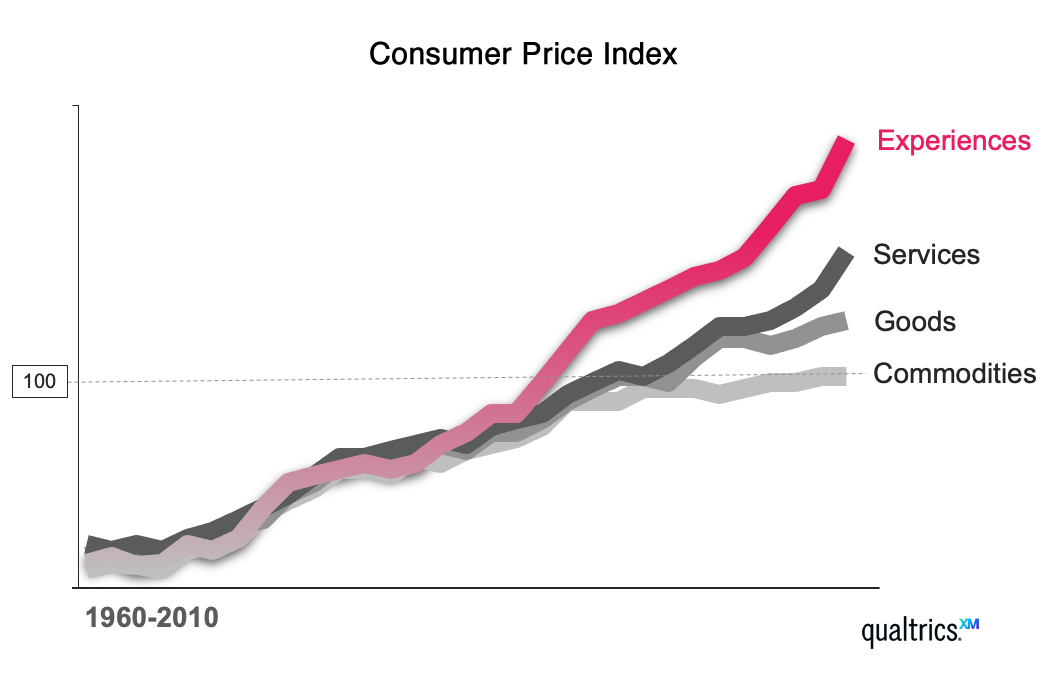
By now you are aware, a company’s relationship with its customers is about much more than improving product ratings or decreasing wait times. Understanding the customer journey is about learning what customers experience from the moment they begin considering a purchase, and then working to make the journey toward buying a product or service as simple, clear, and efficient as possible. But why does this matter? It matters because customers are willing to pay a premium for a great experience. In fact experience is rapidly over taking price as the key product differentiation. If you consider the consumer price index, experience brands significantly outperform commodities, goods, and services.
Learn more
“We built the Starbucks brand first with our people, not with consumers”
Building the Starbucks Experience
There are some companies that have built their strategy on culture and are role-models for others to follow. Let’s take the classic example of Starbucks. Undeniably, Starbucks has been different from the rest ever since it began its journey. Its major focus was not the product; rather, it was the experience and the desire for creating a “third place” for conviviality beyond home and the workplace.
The year is 1970. Three college friends, Zev Siegl, Jerry Baldwin, and Gordon Bowker, decide to get into the coffee business. At that time, Americans usually drank coffee at home or diners.
Their initial focus was to bring high-quality and carefully sourced coffee beans to customers used to drinking instant or canned coffee. That changed with the addition of one man, Howard Schultz – Starbucks marketing lead at the time.
Howard Schultz, the former Chief of Starbucks and currently serving as Chairman Emeritus, has always been known for his unconventional ways in handling his business. While everyone else was talking about products, he talked about the people, the culture, and the employees. On culture and people, he said, “We built the Starbucks brand first with our people, not with consumers. Because we believed the best way to meet and exceed the expectations of our customers was to hire and train great people, we invested in employees.”
The cafe chain claims that is not a coffee provider, but an ‘experience’ provider. Walk into any outlet of Starbucks all over the world and the experience would be warm and welcoming. It’s not because the staff perform certain tasks robotically and coherently. Also, the experience doesn’t lie in just the layout and the décor. Rather, the experience is made special because of the employees such as the staff that take your order so wonderfully. They behave in a manner similar to their counterparts at any other outlet in the world.
By now we all know the the story which has become one of the more famous origin tales in Corporate America. In the early 1980s, Schultz was running sales for a high-end Swedish housewares company and noticed that a small coffee chain in the Pacific Northwest was buying a lot of its drip coffee makers. He visited the Starbucks Coffee, Tea and Spice Company, was taken with the coffee’s quality — back then it was only sold as whole beans — and persuaded the small operation to let him join as its marketing director.
It was that role, he went to Italy for a trade show, so goes the corporate lore, and fell in love with Italy’s cafe culture. He devotes nearly a whole chapter to it in his first book, “Pour Your Heart into It,” where he gushes with an almost religious fervor about the “strong sensual flavor”of the espresso he drank there and the “great theater” of the country’s coffeehouses.

Starbucks Performance
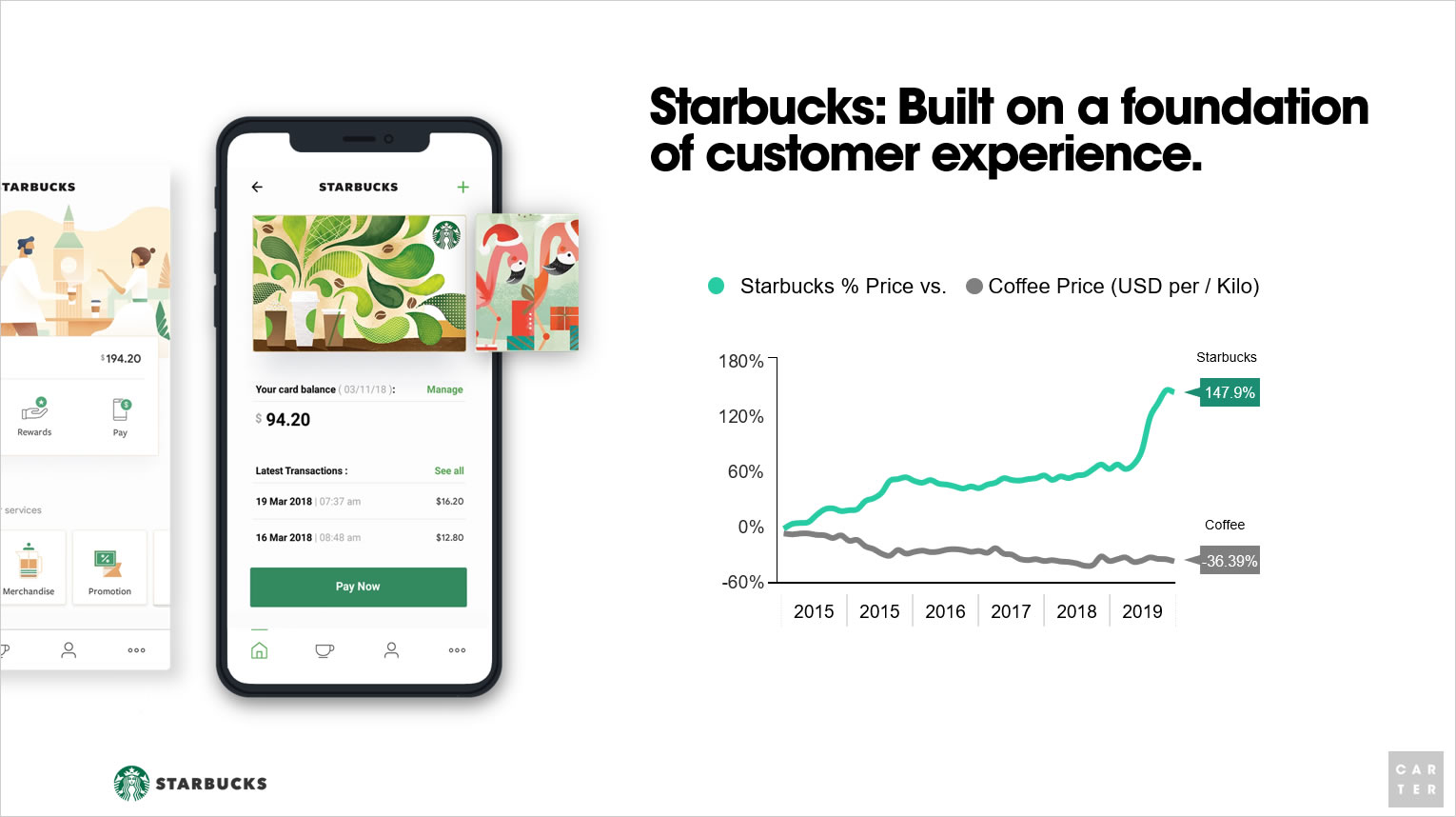
Through focusing on CX Starbucks has built its competitive advantage primarily around customer experience at a time when most others are still focusing only on the 4 Ps of marketing ( Price, Product, Promotion, and Place). Further, it also pivoted very effectively according to market needs. No wonder, Starbucks remains one of the most loved brands in the world and is also the poster child of amazing customer experience until today.
So there was the blueprint. If Uber could find a way to fix the ordering process, create more flexible choices, improve the overall ride experience and payment process, they win! And that is exactly what they set out to do…not with a fleet of cars, drivers, and depots. But through technology. And that is the beauty of VoC. It cuts through internal bias and opens up a new uses cases to solve problems. Customer’s did not state “How” they wanted these elements improved, the only indicated “What” they wanted to experience.
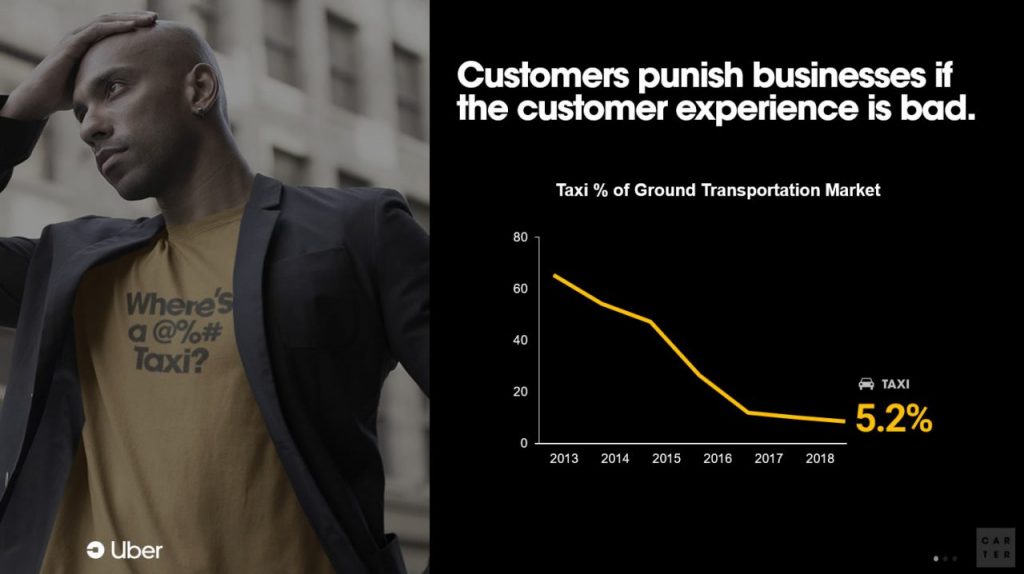
CX disrupts the taxi industry?
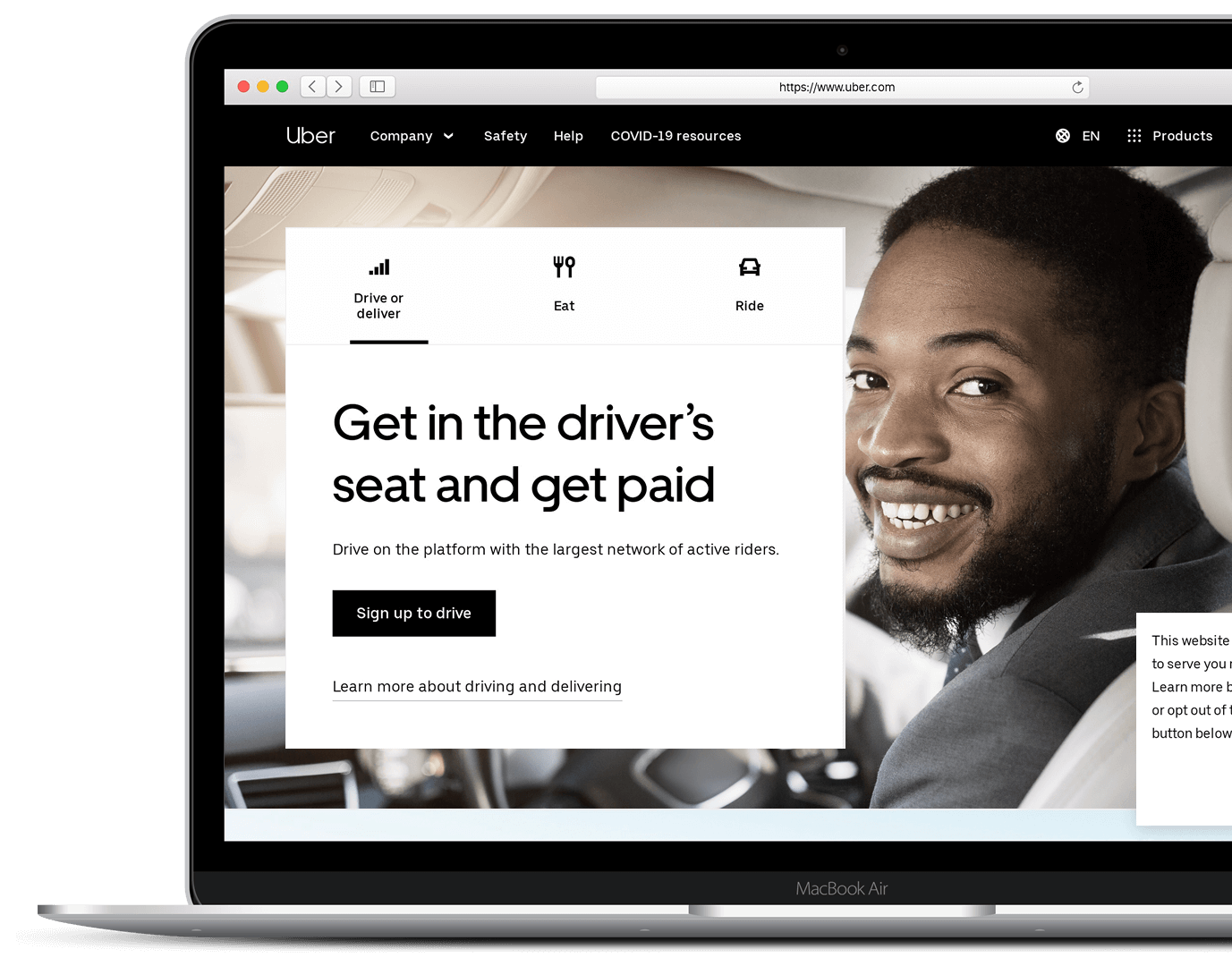
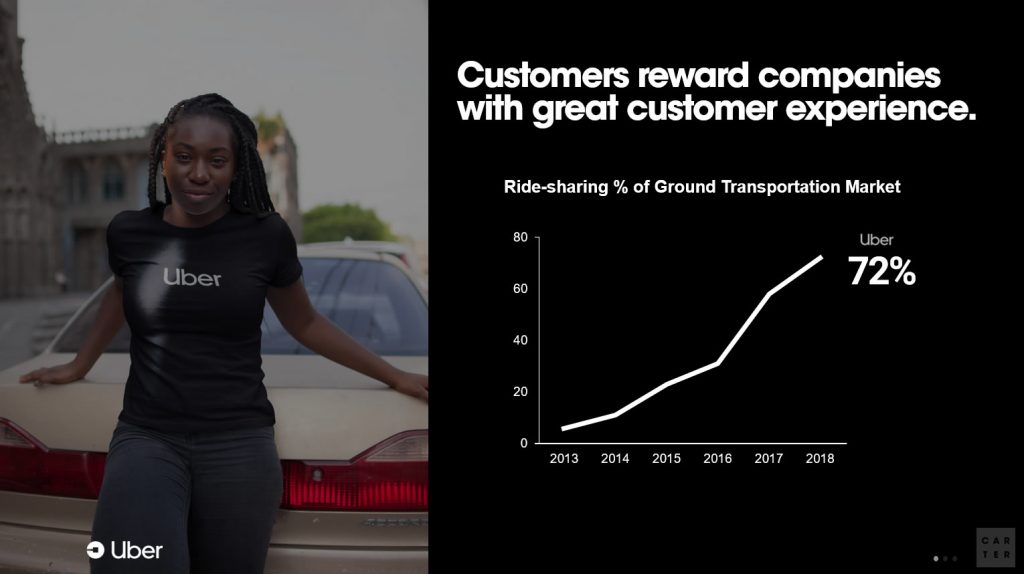
In 2010, Uber began marketing rides in luxury cars. It cost more than a cab at the time, but passengers could simply tap a button on their iPhones and track its movements, instead of calling a taxi dispatch number with no map showing them how close their ride was. It seems ordinary now, but the ability to summon a nice car from the ether felt like magic — especially compared to standing on the curb and hoping a cab passed by or calling one and wondering when it would show up.
Instead of focusing on its own customer experience, the taxi industry reacted to this development with a cease-and-desist letter, threatening a $5,000 penalty for each time Uber operated a car without a taxicab permit. It took particular umbrage with the company’s initial name, UberCab.
And opposition was short-lived. Although Uber removed ‘Cab’ from its name, it continued picking up passengers without permits and used the simplicity of its app to spread to cities worldwide.
The Taxi industries response
The taxi industries response thus far has been to complain, cry foul, block Uber through legislation..even creating bad variations of mobile cab hailing apps… vs. exploring the obvious answer: Listen to your customers and improve their experience. Based on CX feedback, here’s a few basic ideas…
1) Clean the inside of your vehicles. I can’t afford to show up to a business meeting looking like I just dug a ditch; I know that Uber makes their drivers keep their vehicles clean. Guess which option I’ll choose if your back seat looks like someone just had a party back there?
2) Take a little pride in yourself and your job. Dress and act like someone who needs your customers more than your customers need you. If you look too sketchy or scary for me to get into your vehicle, I can get an Uber driver and see his or her name, license plate number, photo, and customer rating in my app before he or she arrives.
3) Learn the geography of the local areas (or at least learn how to use your GPS). The reason I’m in your vehicle is because I have to get someplace important, usually on a tight time frame. If you seem really confused about where I want to go, I’m going to hop out of your vehicle and call an Uber driver, who I can be darn sure knows how to use a GPS.
4) Hang up your phone and focus on driving. Are you trying to scare me by having a heated political debate or an argument with your significant other while driving in heavy traffic? Because that’s what you’re doing. If I instead opt for Uber, the driver will respect my wishes for a little peace of mind.
5) Make it easy for customers to pay with credit cards. For really long rides I need to pay by credit card, and I know that with Uber, payment happens magically through the app – arguments about cash are a non-issue. Not to mention that you will get a bigger tip when the customer pays by credit card. So even though this suggestion does have a cost, that cost is more than offset by the benefits.
What’s Next?
The irony in all this is that despite having its pulse on CX, Uber is bound to fail. Uber bills itself a “technology” company instead of a taxi company. This is because unlike a traditional cab company, for which you use your phone to call for a cab, with Uber…er…you ultimately use your phone to call for a cab. See the irony? The difference is obvious despite its focus on customer pleasing technology, Uber’s business model is to lose money for years or decades to grow its market and then, eventually, replace human drivers with autonomous vehicles. It’s true, just look at their investments and acquisitions in that space.. In the meantime Uber has lost more money than any start-up in human history.
Uber’s rates in most U.S. cities are less than $1 a mile and 10 cents a minute, taxi meter rates haven’t been that low since the Great Depression.
The short answer is that they don’t charge enough. Uber’s rates in most of the USA are less than $1 a mile and 10 cents a minute. How long ago were taxi meter rates that low? Well, that depends if you want to correct for inflation or not. For New York City taxi rates (which are roughly similar to SF’s) to get that low in non-adjusted dollars, you’d have to set your way-back machine to 1980, when you could rent a three-bedroom apartment for under $500 a month. In Nob Hill.
If you correct for inflation, and you’d have to go back to…well, an alternate reality, because regulated taximeter rates have probably never been so low in the USA. Go back to the Great Depression, when SF meter rates were 30 cents a mile — that’s $4.68 adjusting for inflation per the US Bureau of Labor Statistics. How can Uber ever make money charging 20 percent of that? The answer is they can’t. So how are they still functioning? By looking like successful operations. The companies keep their massive driver presence (and quick, cheap service) by offering large subsidies.
Uber’s business model is not just flawed; it’s absurd. The taxi industry has been massively regulated for decades in the United States. Not because we live in a Marxist hellhole where the state has its finger in everything, but because the industry itself recognized that the only way it could maintain a modest profit margin was to restrict supply by requiring cabs to have government-issued medallions (permits). In fact, the strongest supporters of government regulation in the taxi industry have always been the medallion holders. By contrast, Uber has eliminated the exact mechanism that keeps it profitable. It’s like lions chasing away all the gazelles and then bragging about how they “streamlined” the Savannah.
Conclusion
Okay, even if Autonomous Vehicles (AV) become reliable, are cheap, accepted and legal, and without artificial restriction of supply, what will prevent competitors from just undercutting Uber by a penny per mile until nobody is making money? What then, rely solely on brand loyalty?
Uber is heading down a one-way, dead-end ally, and I think they’ve known it from day 1. To distract us (and themselves), they spend big money on very public AV development (including helicopter drones, allegedly just two years away) so investors keep investing. Imagine if in the middle of all this the Taxi industry just got its sh*t together and focused on CX?