
How Lyft used CX analytics to disrupt an industry.
To understand how Lyft & Uber used Customer Experience to disrupt the Taxi Industry, you have to understand how the state of that industry made it ripe for takeover. First was the antiquated practice known as the “Medallion”. A taxi medallion is simply a transferable permit allowing a taxicab driver to operate. A number of major cities in the US use these in their taxi licensing systems, including New York, Boston, Chicago, Philadelphia, and San Francisco. Medallions may be worth hundreds of thousands of dollars. The New York medallions are the most valuable, once peaking at over one million dollars.
Learn more
“At one time the Washington Post reported that ‘Medallions were the best investment in America’”
Add that to the fact that in San Francisco alone, the taxi industry comprises 24 cab companies, eight dispatch services, and roughly 1,500 medallions, which fall under six distinct categories. Individual drivers often pay a daily “gate fee” to companies known as “color schemes” for the cars they own and manage. Historically, medallions have been highly coveted, and owners often lease them out to companies or the 4,000 currently active drivers, collecting a cut of the ride profits.
If this sounds convoluted, it is.
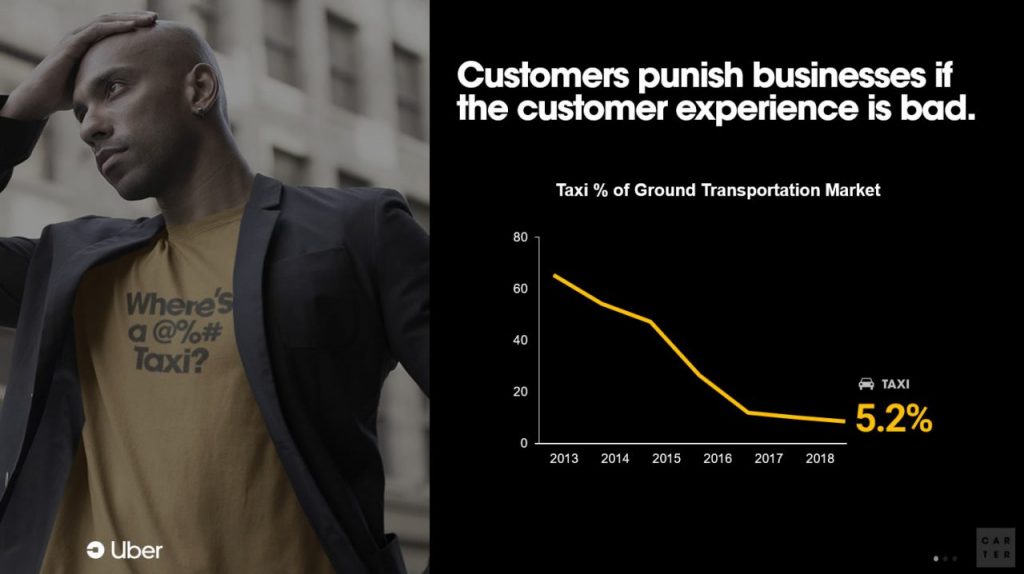
Dispatch of taxis had always been inefficient, leaving customers unsure of just when the cab was coming, if at all. The industry even opposed credit cards, until the city forced cab companies to accept them in 2011. This caused cab companies to push credit card processing fees onto the driver, which in turn caused them to frequently claim the “machine is broken”. Some drivers were selective about who they picked up, leading to accusations of discrimination. Too often, riders couldn’t count on them to show up.
Customer Experience Analytics
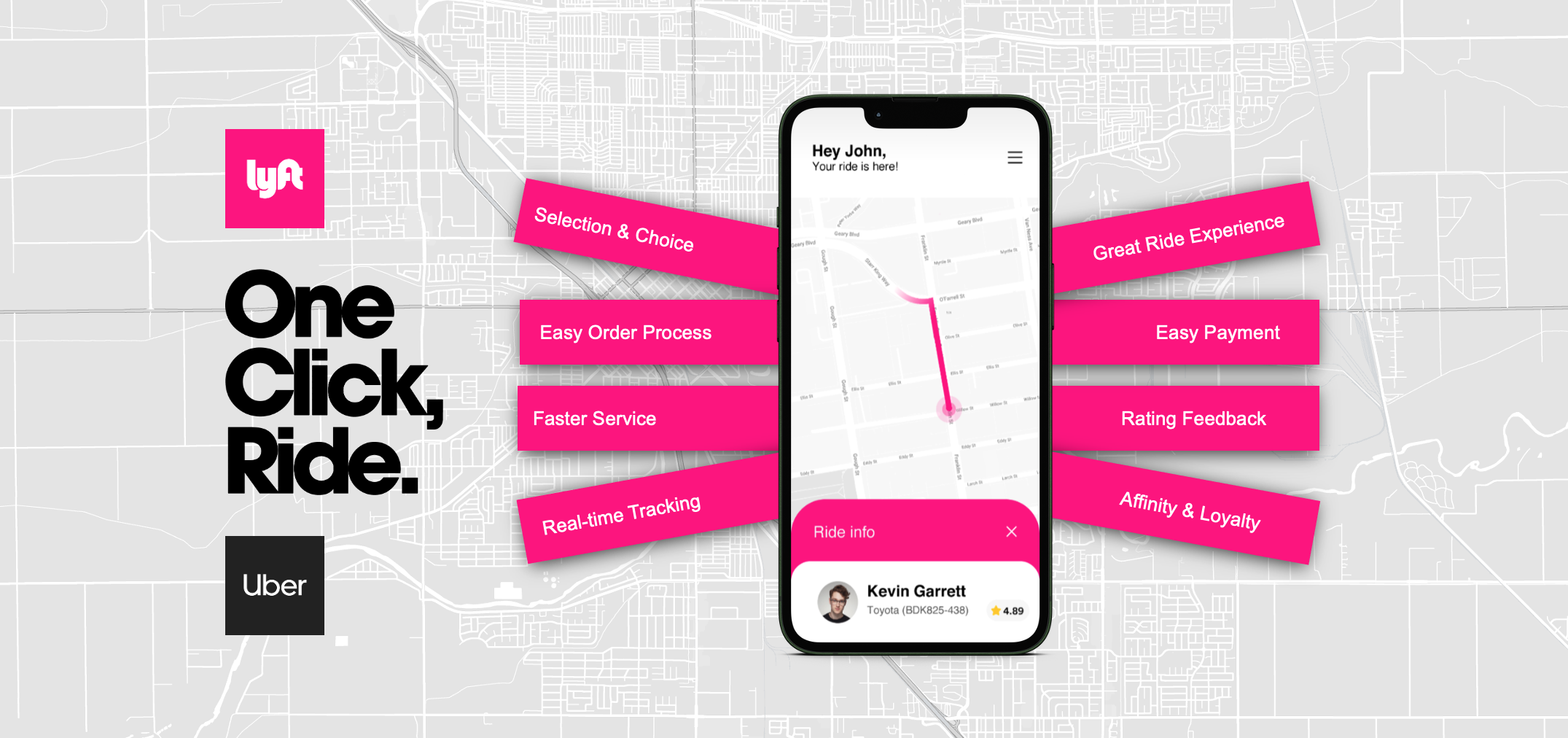
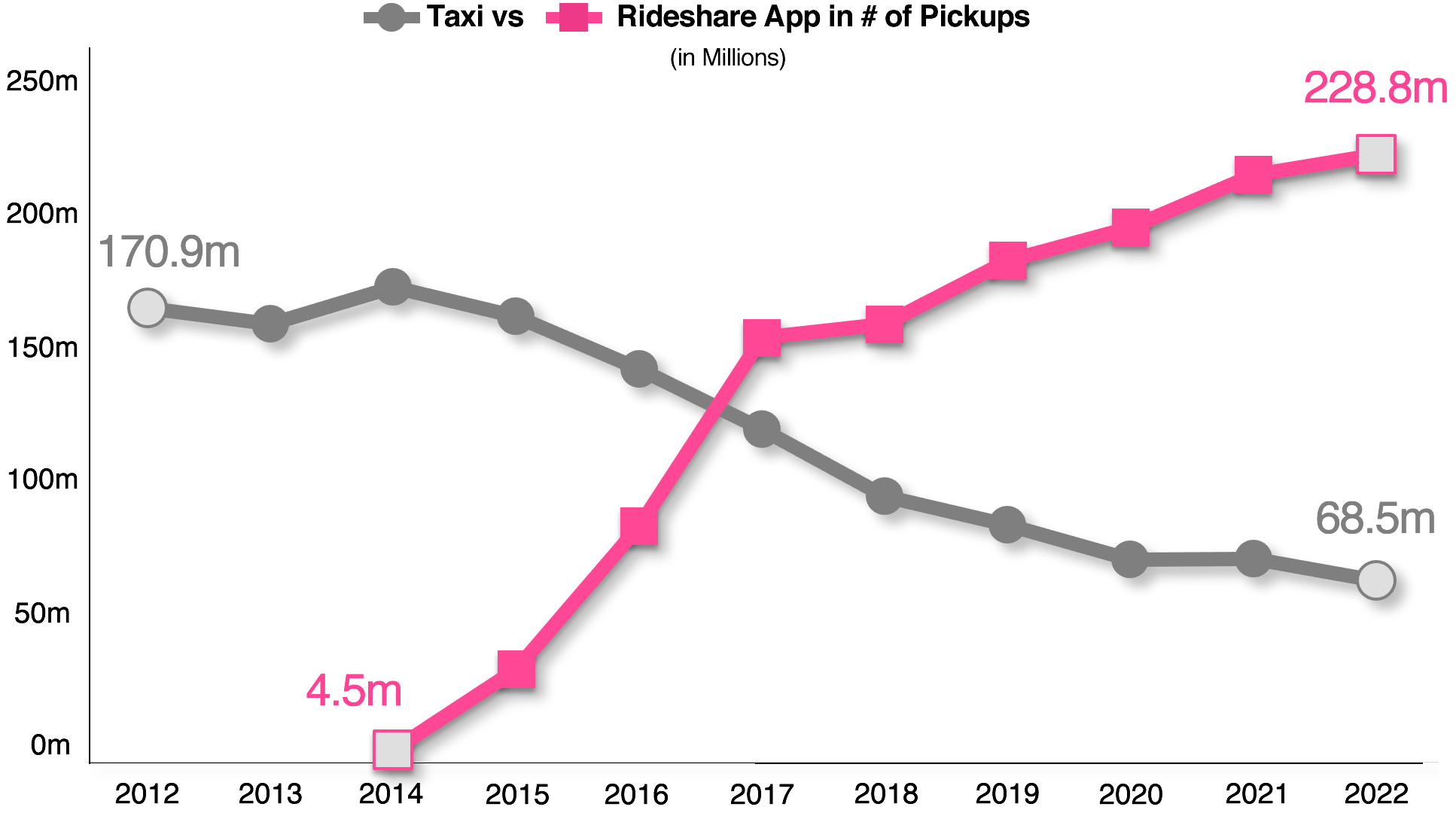
So here’s where Rideshare apps come in. For example before writing a single line of code, Uber knew the taxi industry was ripe for a take down, but the questions was where and how to attack! So they let the Voice of the Customer (VoC) be their guide. They simply asked people what they disliked about Taxi’s and it netted out to five common themes
So there was the blueprint. If Uber could find a way to fix the ordering process, create more flexible choices, improve the overall ride experience and payment process, they win! And that is exactly what they set out to do…not with a fleet of cars, drivers, and depots. But through technology. And that is the beauty of VoC. It cuts through internal bias and opens up a new uses cases to solve problems. Customer’s did not state “How” they wanted these elements improved, the only indicated “What” they wanted to experience.
CX disrupts the taxi industry?
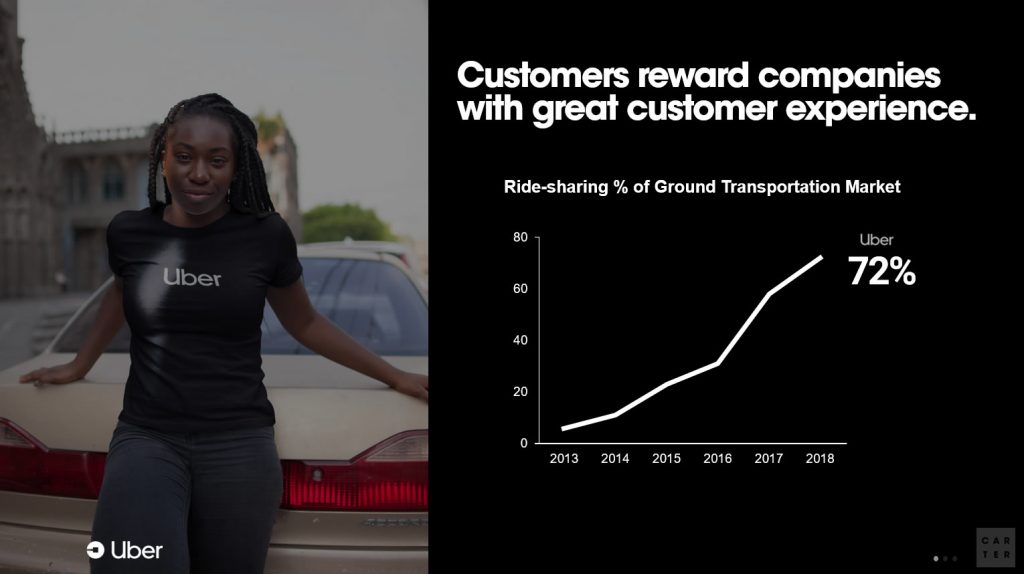
In 2010, Uber began marketing rides in luxury cars. It cost more than a cab at the time, but passengers could simply tap a button on their iPhones and track its movements, instead of calling a taxi dispatch number with no map showing them how close their ride was. It seems ordinary now, but the ability to summon a nice car from the ether felt like magic — especially compared to standing on the curb and hoping a cab passed by or calling one and wondering when it would show up.
Instead of focusing on its own customer experience, the taxi industry reacted to this development with a cease-and-desist letter, threatening a $5,000 penalty for each time Uber operated a car without a taxicab permit. It took particular umbrage with the company’s initial name, UberCab.
And opposition was short-lived. Although Uber removed ‘Cab’ from its name, it continued picking up passengers without permits and used the simplicity of its app to spread to cities worldwide.
The Taxi industries response
The taxi industries response thus far has been to complain, cry foul, block Uber through legislation..even creating bad variations of mobile cab hailing apps… vs. exploring the obvious answer: Listen to your customers and improve their experience. Based on CX feedback, here’s a few basic ideas…
1) Clean the inside of your vehicles. I can’t afford to show up to a business meeting looking like I just dug a ditch; I know that Uber makes their drivers keep their vehicles clean. Guess which option I’ll choose if your back seat looks like someone just had a party back there?
2) Take a little pride in yourself and your job. Dress and act like someone who needs your customers more than your customers need you. If you look too sketchy or scary for me to get into your vehicle, I can get an Uber driver and see his or her name, license plate number, photo, and customer rating in my app before he or she arrives.
3) Learn the geography of the local areas (or at least learn how to use your GPS). The reason I’m in your vehicle is because I have to get someplace important, usually on a tight time frame. If you seem really confused about where I want to go, I’m going to hop out of your vehicle and call an Uber driver, who I can be darn sure knows how to use a GPS.
4) Hang up your phone and focus on driving. Are you trying to scare me by having a heated political debate or an argument with your significant other while driving in heavy traffic? Because that’s what you’re doing. If I instead opt for Uber, the driver will respect my wishes for a little peace of mind.
5) Make it easy for customers to pay with credit cards. For really long rides I need to pay by credit card, and I know that with Uber, payment happens magically through the app – arguments about cash are a non-issue. Not to mention that you will get a bigger tip when the customer pays by credit card. So even though this suggestion does have a cost, that cost is more than offset by the benefits.
What’s Next?
The irony in all this is that despite having its pulse on CX, Uber is bound to fail. Uber bills itself a “technology” company instead of a taxi company. This is because unlike a traditional cab company, for which you use your phone to call for a cab, with Uber…er…you ultimately use your phone to call for a cab. See the irony? The difference is obvious despite its focus on customer pleasing technology, Uber’s business model is to lose money for years or decades to grow its market and then, eventually, replace human drivers with autonomous vehicles. It’s true, just look at their investments and acquisitions in that space.. In the meantime Uber has lost more money than any start-up in human history.
Uber’s rates in most U.S. cities are less than $1 a mile and 10 cents a minute, taxi meter rates haven’t been that low since the Great Depression.
The short answer is that they don’t charge enough. Uber’s rates in most of the USA are less than $1 a mile and 10 cents a minute. How long ago were taxi meter rates that low? Well, that depends if you want to correct for inflation or not. For New York City taxi rates (which are roughly similar to SF’s) to get that low in non-adjusted dollars, you’d have to set your way-back machine to 1980, when you could rent a three-bedroom apartment for under $500 a month. In Nob Hill.
If you correct for inflation, and you’d have to go back to…well, an alternate reality, because regulated taximeter rates have probably never been so low in the USA. Go back to the Great Depression, when SF meter rates were 30 cents a mile — that’s $4.68 adjusting for inflation per the US Bureau of Labor Statistics. How can Uber ever make money charging 20 percent of that? The answer is they can’t. So how are they still functioning? By looking like successful operations. The companies keep their massive driver presence (and quick, cheap service) by offering large subsidies.
Uber’s business model is not just flawed; it’s absurd. The taxi industry has been massively regulated for decades in the United States. Not because we live in a Marxist hellhole where the state has its finger in everything, but because the industry itself recognized that the only way it could maintain a modest profit margin was to restrict supply by requiring cabs to have government-issued medallions (permits). In fact, the strongest supporters of government regulation in the taxi industry have always been the medallion holders. By contrast, Uber has eliminated the exact mechanism that keeps it profitable. It’s like lions chasing away all the gazelles and then bragging about how they “streamlined” the Savannah.
Conclusion
Okay, even if Autonomous Vehicles (AV) become reliable, are cheap, accepted and legal, and without artificial restriction of supply, what will prevent competitors from just undercutting Uber by a penny per mile until nobody is making money? What then, rely solely on brand loyalty?
Uber is heading down a one-way, dead-end ally, and I think they’ve known it from day 1. To distract us (and themselves), they spend big money on very public AV development (including helicopter drones, allegedly just two years away) so investors keep investing. Imagine if in the middle of all this the Taxi industry just got its sh*t together and focused on CX?