
The Rise of Blockbuster Video

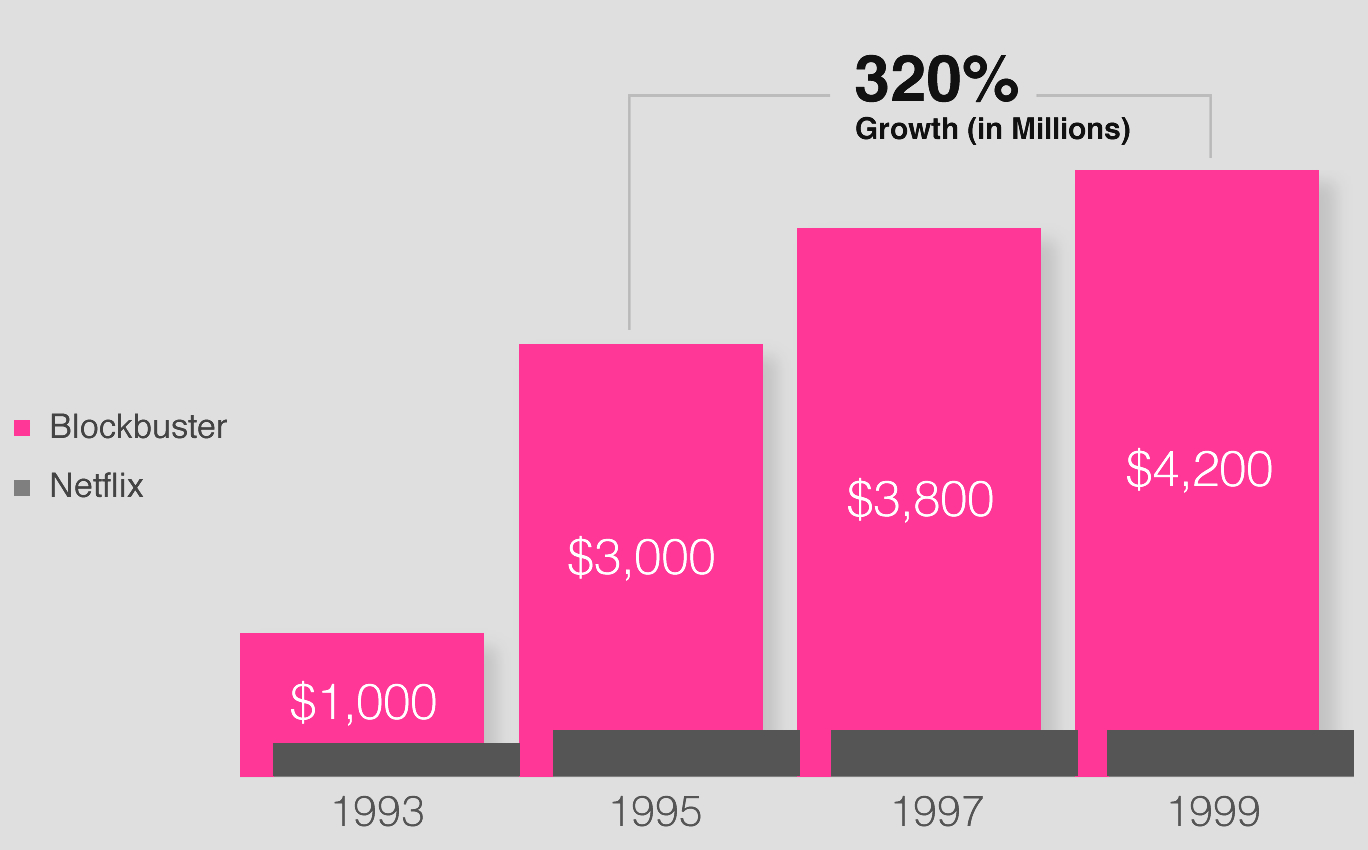
For those of you too young to really remember Blockbuster video; once a upon a time families made a trip to Blockbuster to rent a movie. It was a lot like going to the library. You’d browse the store, pick up a new release for a couple bucks, and have a couple days to watch your movie. If you brought it back late, you got late fees. At its peak, Blockbuster had over 9,000 video-rental stores in the United States alone, employed about 84,000 people worldwide, and had 65 million registered customers. It was valued at $3 billion.

Learn more

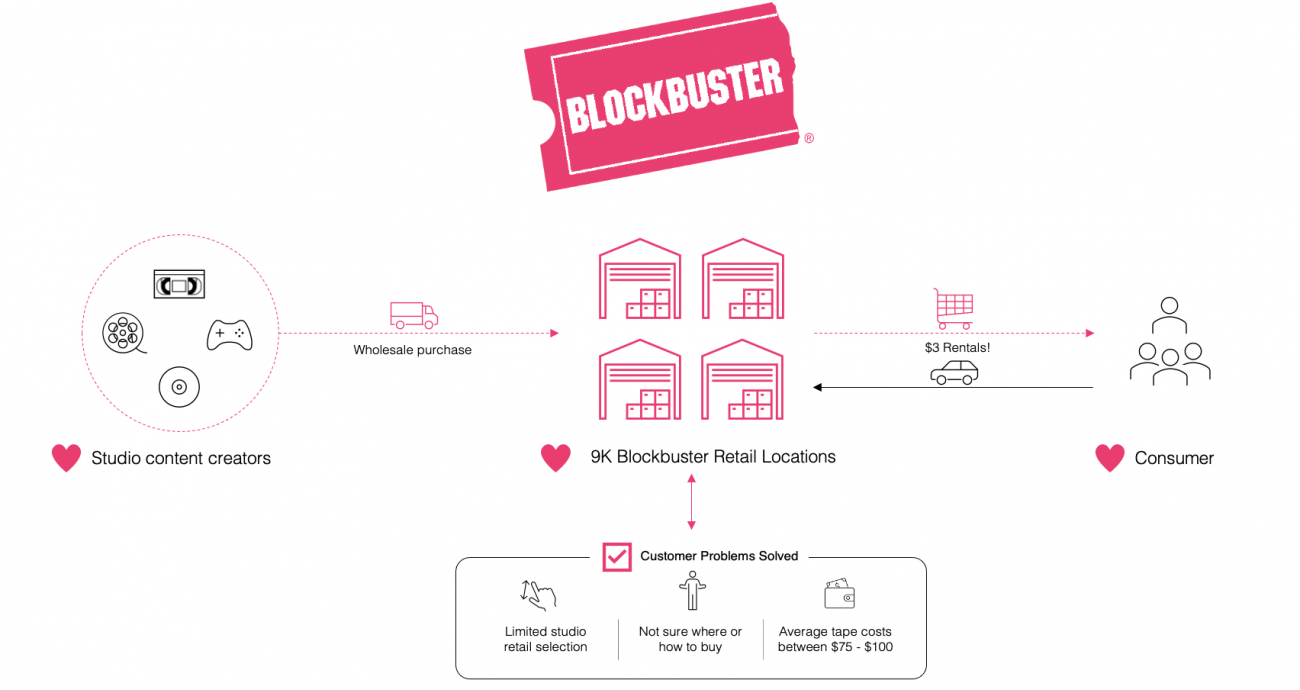
How they did it: Blockbuster leveraged exclusive agreements with publishers in order to pass on cost savings to customers. Customers paid a monthly fee for video rental. In addition to benefiting from a lower initial price, Blockbuster also capitalized on the fact that movies were not generally available for purchase at affordable price points which at that time ranged between $70–$100 per title. Thus customers had a choice, either buy the film on tape at the much higher manufacturer’s suggested retail price, or rent at a much lower price.


Value Model: During the peak years, Blockbusters value model made good sense. Customers really had no idea where to buy video tapes, the cost of the tapes they could find was very high, and this restricted selection and choice. Or you could just drive to Blockbuster and find a wall of movies that you could simply rent for only $3 bucks!

Blockbuster Business Model

Blockbuster Business Model 01

Business Model: The cost of maintaining, staffing, and expanding their stores resulted in two main constraints: 1) costs did not scale well as each new market required heavy investment in a new location and 2) once a location was established, profits, albeit with high variable contribution, were tied with recouping the upfront capital investment. This caused a mismatch between the customer experience (e.g., low-friction rental and time to enjoy a VHS) and Blockbuster’s profit model (e.g., high rental turnover). To incentivize on-time returns, Blockbuster introduced high late fees which, before long, accounted for up to 70% of Blockbuster’s revenues (3). Blockbuster’s business shifted from renting movies to collecting late fees!

Blockbuster Revenue Sources

Business Model vs. Value Model Conflict: Despite its reliance on late fees, Blockbuster realized that that this was not a customer delighting practice and eliminated them in 2005. However, a major weakness of Blockbuster’s position was its brick-and-mortar distribution system with 9,000 stores at its peak. These infrastructure investments, combined with management’s bias toward the historical success of the brick-and-mortar strategy, added significant costs and restricted Blockbuster’s ability to innovate effectively and quickly. So Blockbuster did the unthinkable, and re-introduced late fees in 2010 to shore up revenues. And to boost these fees they created opaque late fee policies and inconvenient customer experience which ran counter to the customer value proposition.

Although no one would want to admit it, Blockbuster didn’t make much money from the simple rental of movies. They earned their profits by charging late fees to customers. Netflix could completely change the dynamic of the business profile of Blockbuster by offering a late fee free experience. People could keep the movie for however long they wanted and just pay a monthly fee. Even the postage was pre-paid.

What makes more sense to the customer? Patronizing a business that will charge you late fees for being 10 minutes late? Or having a fee-free existence? Even responsible customers could damage Blockbuster’s profit profile. If they returned movies on time all the time, there would be no real way for the company to make money.

"Blockbuster turned out to be the worst investment I've ever made...

Enter Netflix.


To be fair to Blockbuster, Netflix had its own disadvantages. Before the consumption of digital content developed, Netflix started out as a DVD rental service.  And in the early days, It took close to a week to replace movies so you had to constantly update an online list and then hope that you’d get the next movie you wanted to see. There was no guarantee.

So what actually wound up destroying the Blockbuster business model not the powerful content giant of today’s Netflix, but rather simple customer experience choice: To patronize a business that will charge you late fees for being 10 minutes late, or a business that offered viewing flexibility and choice with no penalty? Said a simple way, Blockbuster’s very profit model was built on bad CX and no amount of post-CX, i.e. free plastic buckets with microwave popcorn and licorice at check-out, would change that.  And as the more people experienced Netflix, they enjoyed it, and told their friends. Eventually the word of mouth created new subscriptions. People still held onto Blockbuster, but the peer pressure of everyone going to Netflix and liking created a threshold that eventually allowed one business to dominate and the other to file for bankruptcy.


Conclusion.

The idea that Netflix killed Blockbuster isn’t exactly correct. The really is that penalizing customers to make money is a bad business model. A business should be creating a positive income source rather than a negative income source. In fact, the Redbox business model is an example of this. Instead of charging late fees, they charge customers a daily rental fee up until a certain point and then the movie becomes theirs. Instead of late fees, people choose to pay extra rental fees to purchase the content instead. One is in business, the other is bankrupt.


A more accurate conclusion is that Blockbuster suffered a fatal self-inflicted wound that was exacerbated by Netflix, but not it its cause.