Have current customer success practices jumped the shark?

The general premise of customer success is anticipating customer challenges or questions and proactively providing solutions and answers. And that customer success helps businesses boost customer happiness and retention, thus increasing revenue and customer loyalty.

What is the core issue?

The problem is that Customer Experience, or CX, takes a common-sense premise and turns it into an opportunity for “category creation,” which essentially means dreaming up a new class of products and selling them at a premium. Consider Sara Blakely’s creation of Spanx and Kevin Plank’s creation of Under Armour, now $1 billion brands that have effectively reinvented the way consumers think about girdles and T-shirts.


Furthermore, many companies had already created customer-first culture and branding long before CX was a thing. The Ritz-Carlton, for example, has a long-held motto that sets the tone for employee loyalty and engagement: “We are Ladies and Gentlemen serving Ladies and Gentlemen.” This classy motto is more than a clever twist on words; it’s at the core of how Ritz-Carlton views its staff and customers. Disney, the “Happiest Place on Earth,” is widely recognized for its magical customer experience approach. Today, both Ritz-Carlton and Disney are the gold standard of excellent customer experience. Both companies ironically now contribute to the CX “categorization economy” through the Ritz Carlton Leadership Center and the Disney Institute.

CUSTOMER EXPERIENCE

Today’s Customer Experience sounds reasonable but is it rationale?

The problem is that Customer Experience, or CX, takes a common-sense premise and turns it into an opportunity for “category creation,” which essentially means dreaming up a new class of products and selling them at a premium. Consider Sara Blakely’s creation of Spanx and Kevin Plank’s creation of Under Armour, now $1 billion brands that have effectively reinvented the way consumers think about girdles and T-shirts.


Hopefully, you see the core issue: There is no such thing as no CX. Before Ritz and Disney joined the CX bandwagon, their very business models were common-sense formulas for CX: Expectation (Brand Promise) – Reality (Product + Experience) = Frustration (Level). So if Disney’s brand promise is the “Happiest Place on Earth,” you can assume an expectation score of 10 (on a scale of 0 to 10). And when you visit one of its theme parks, say the product (0-5), plus the and experience (0-5) equal a reality score of 10; then you have a zero frustration score. Or (10 – ( 5+5 ) = 0).


But why focus on eliminating “frustration”? Because concentrating on customer “delight,” as many CX programs do, ignores examining the overall business model. For most customers, delight is simply the absence of frustration. So eliminating frustration is stating what you do and doing it ( E-R=F). If you were to focus solely on a “delighting experience,” you could be ignoring ensuring that your brand promise, products, and experience align across your business model.


So building a “CX Program” on top of a flawed business model is like adding the yeast after you have baked the bread.

CX is more of a business model

I recall attending a Customer Experience conference where they discussed the importance of creating a “CX listening analytics platform” that could assess customer satisfaction and risk throughout the customer journey. Of course, accomplishing this would require their software, an initial VOC (voice of customer) analysis, multiple consulting engagements, post-implementation support, etc.


I couldn’t help but wonder what sort of crappy business models (or poor results) were the people in the audience hoping to correct with “a fresh coat of CX.” For some reason, this all hit me like an old episode of MTV’s “Pimp My Ride.” If you are not familiar with PMR, it ran on MTV in the early 2000s and consisted of taking crappy cars in poor condition and customizing them.


The key question here is, can any amount of customization transform a beat-up Honda Accord into a new Mercedes?


So when you consider that upwards of 73% of CX initiatives fail, it further suggests that an “aftermarket approach” may not be practical to improve companies either. Additionally, the same study found that “only 30% of respondents said that key stakeholders were truly invested in the goals of the program.”


To be fair, CX’s genesis as a strategic initiative was customer feedback that panned buying and post-sales experiences. However, customer feedback typically does not attribute the cause to a particular problem like product failure or service breakdowns. The message: overall, the experience of dealing with Company X is simply crappy. Companies correctly interpreted many of these complaints are systemic, cross-departmental problems and attempt to solve them under the CX umbrella.


CX Market Cap
Today's customer success software and services represent a $10 Billion industry.
CX Market CAGR
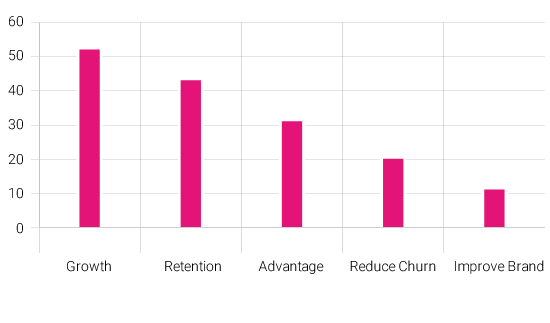
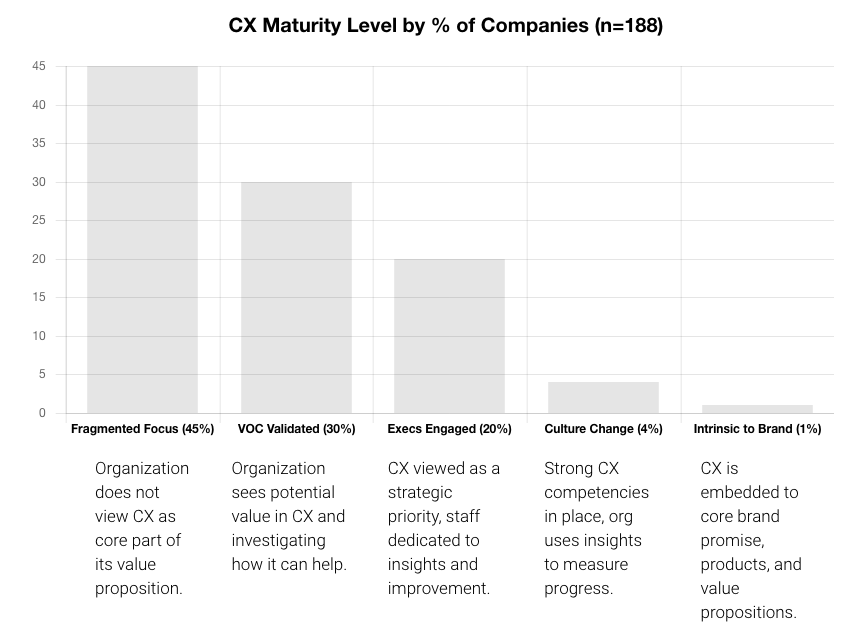
Although only 1 of 5 companies are fully committed to CX as a value center drive sustainable growth., CX GAGR is over 18%
CEOs investing in CX
Although only 1 of 5 companies are fully committed to CX as a value center drive sustainable growth., CX GAGR is over 18%

Part of the problem lies in the fact that:

1) CX doesn’t need to be a thing in the first place. When a company is doing its job delivering value, when it is behaving ethically and in the customer’s interests, and when they provide consistent quality in product and service, doesn’t CX take care of itself?


2) CX results can look good or bad because the wrong things are measured. Incorrect CX measurement is a typical problem in manufacturing and sales. It may make more sense to focus on quality rather than traditional throughput metrics to improve manufacturing outcomes. It wasn’t until companies looked at the Lifetime Value of customers rather than simple revenue achievement did companies achieve better growth and higher profitability in sales.

-

% of NPS leaders that believe score is growth indicator

-

% of NPS laggers that believe score is growth indicator

Ultimately, the promise of growth and competitive advantage is so enticing; companies make significant CX investments despite a weak business case for measurable ROI. Professional CX’ers understand the need to measure ROI,however few discuss the intricate details of doing that. Therefore, the typical business case for CX relies on weak correlation analysis between engagement, customer survey ratings, and company-level growth or revenue per customer.


Net Promoter Score (NPS), the most hyped CX measure, is logically connected (inferred) to improved financial results, but honestly, has weak quantitative support. Despite this, a Forrester publication identified a positive correlation between NPS and company revenue growth. This sounds good, except there was no publication of analysis isolating NPS from other potential growth drivers:


  • Having a superior product
  • Having large and memorable marketing expenditures
  • What about geographic expansion or blunders by competitors?


It would be very expensive to complete survey samples that are large enough to do statistically significant correlation analysis that can separate multiple explanatory variables. It would also be important to cover a timeframe that matches revenue measures.

So what’s the answer?


I have learned the hard way that CX is not a “brandaid.” It is not an accessory that you can bolt on to your business (“Pimp My Product”). The only way you will see a positive ROI is to integrate CX into the DNA of who you are and what you do. Like that MTV show, no amount of customization can turn an old Camry into a Mercedes; an “aftermarket CX program” will not turn a poor product experience into loyalty and retention.


Ultimately what makes Ritz Carlton and Disney so amazing (and rare) is that great customer experience is intrinsic to the product.


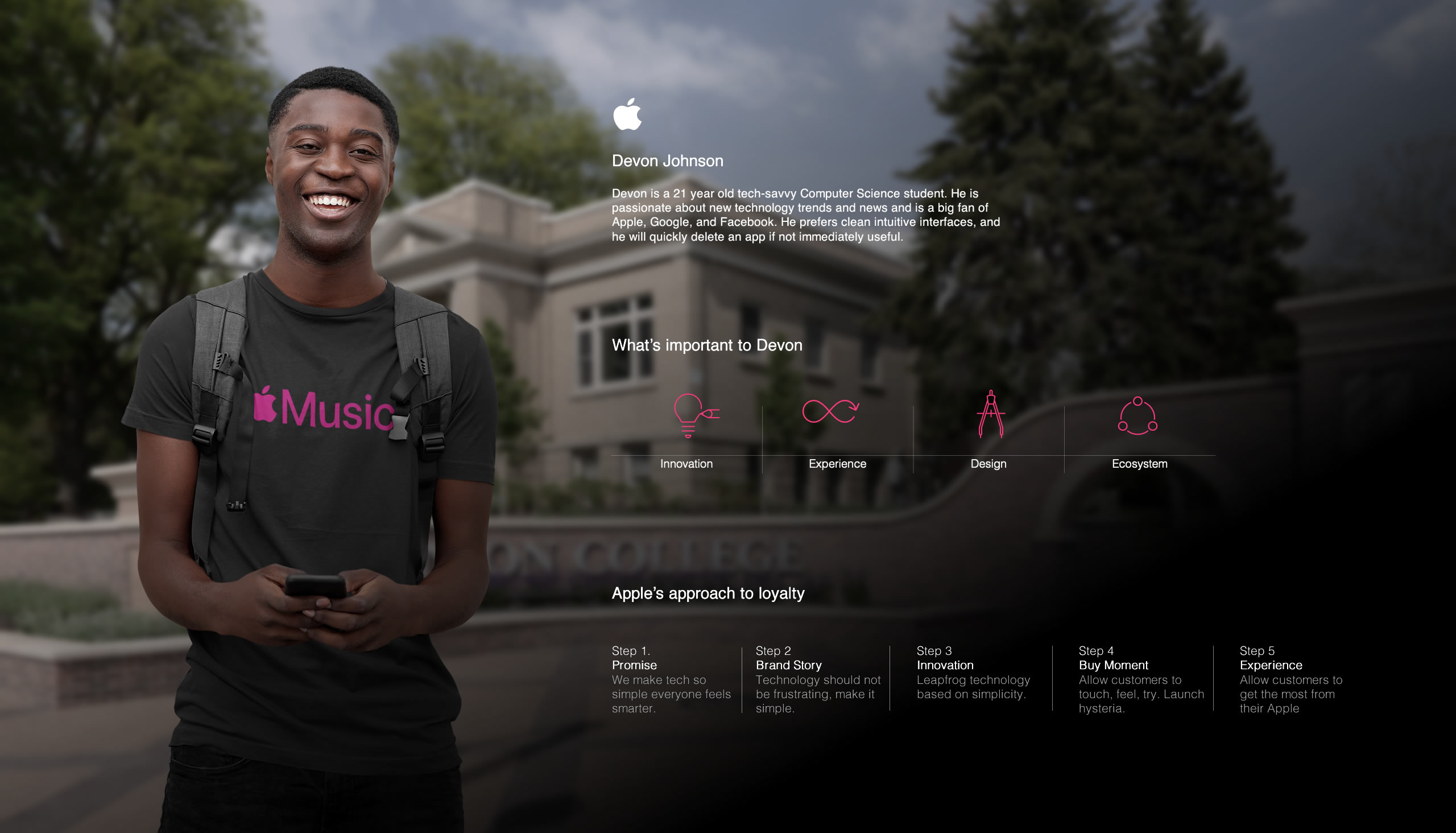
Intrinsic CX is whole different ball-game. It’s not about creating an ‘after-market’ CX program by improving customer support, or driving use and adoption program. The most loyal brands have embedded experience in to the core of their brand. Consider the loyalty score of Apple vs. Lenovo. Both companies offer comparable consumer tech products, yet Apple enjoys a significantly higher NPS score.

logo-apple-dark
logo-lenovo-dark
logo-hp-dark
NPS
NPS
NPS

Apple’s loyalty (and high NPS) is not a coincidence. It is the result of an incredible focus on delivering a great product and an exceptional experience to customers – something Apple, as the world’s largest tech company, has turned into a streamlined process.  Apple’s Net Promoter Score is very high for a company in its industry, but it’s not unattainable for other brands. By understanding why and how Apple achieves high customer loyalty you start to understand why superior CX while not impossible, is very hard to achieve as an afterthought.

So what is the easiest way to think of Customer Experience?


A simple approach I developed to explain customer experience to senior leaders is “5-P” (Problem, Promise, Products, Price, Proof). Companies that have alignment across these domains typically have an intrinsic customer experience and superior brand loyalty.  Moving away from Apple, let’s examine these dimensions using Amazon as an example.

Purpose

I want the ability to buy almost anything from anywhere through a single omni-channel experience

Promise

We are constantly innovating with new customer products, one-day shipping, easy returns, and unoparalleled support

Products

Amazon combines AI and a Google-like ability to search with an ability to sort by Brand Reviews, Price, and availability

Price

Amazon itself is free, but for another $100 per year Prime offers free expedited shipping, music, movies, and more!

Proof

Oh average Amazon Prime members, even using only a fraction of the benefits, save approximately $1000 to $1400 a year

Conclusion


The bottom line is that CX software and consultancies often hold-up companies with intrinsic CX brands as the power and promise of CX. In reality your company will never reach that level of CX Maturity (and ROI); and this is where CX has jumped the shark. That said, some level of CX Maturity is very important to all companies. It is a matter of choosing the right level of maturity to target and establishing an appropriate budget to reach that goal.